


|
|
![]()
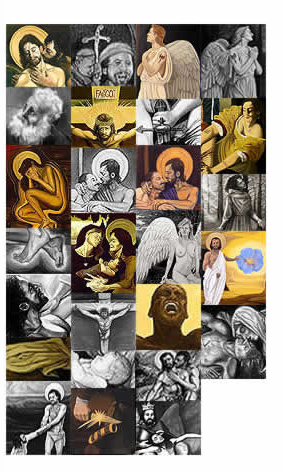
The magic in these pieces is the way they combine unexpected elements like Jesus and "Faggot" on a single canvas to challenge belief and disbelief
gayhistory.com offers an introduction to the stories and the people of modern gay history (1700-1973) |
||
Judas Kiss debuted at Leslie-Lohman in New York 1995. Madonna, Lover & Son debuted at Leslie-Lohman in New York 1998 The Crucifixion of Christ debuted at Blue Milk Group in Atlanta 2001 |
|
online reviews From the writer of GayHistory.com Wik Wikholm mail@gayhistory.com Santa Barbara, CA, USA It's Sunday morning and instead of burying myself in the Sunday New York Times like I usually do, I visited your web site. I feel privileged to have been invited. A photo of a painting (especially one on a computer monitor) is never as real as the thing itself, but even the RGB images on my tube conveyed the power of your art. At
first glance, the paintings' combination of technical virtuosity and
the familiar props of religious paintings seemed to promise an uncomplicated
exercise in belief. After a second or two, though, the tension set in,
a tension that challenges belief and disbelief in different but I am now an atheist and when I look at the paintings the religious props remind me of the illustrations in the Bible I was forced to read as a child. They challenge my disbelief, my rejection of myth as a proper human endeavor. To my atheist eye, Piss Christ is far easier to look at than The Crucifixion of Christ. Having been reared a Christian, though, I can still see the paintings with a believer's eye, an eye that sees sacrilege. The Bible never says that Jesus was called a faggot, that a woman raised Christ from the dead, or that the Son of God protected drag queens. I imagine a self-righteous preacher growling How dare you! For me, the magic in these pieces is the way they combine unexpected elements like Jesus and "Faggot" on a single canvas to challenge belief and disbelief at the same time. The paintings don't reject myth in the atheist way, but they aren't fawning expressions of belief, either. Instead, they play with Bible stories by rewriting them so that they are more inclusive than the ones we were raised with. I can see that some would experience your paintings as an expression of ambivalence about belief, but to me they seem like visual creations of new stories that appropriate not just the props of Christian art, but its power, too. The size, the color palette and the skilled execution of the paintings demand that they be treated with as much reverence as any painting hanging in a church. No wonder your work inspires so much controversy! I
hope that you find more venues that will display your work. I respect
your courage in trying to show it in Atlanta, right in the middle of
the Bible Belt. I
enjoy the metaphoric look at religion you offer. This is just my interpretation,
but I see your work as a very simple message reflecting the points that
Christ often made: we are all images of God and loved by God. Jesus
said that what we do to others, we also do to him. When Jesus defended
the woman caught in adultery, he also showed his protection of other
condemned people. When Jesus socialized with prostitutes, a tax collector,
and (gasp!) the common people, he also showed his willingness to fellowship
with gays and lesbians. When we assault women, blacks, or homosexuals,
we also assault the Creator. I'm sure it gets more complicated than
that, but those are the central messages I see. TOP |
|